Saturday, May 26, 2012

All The News Thats Fit To Print

In USA Today style, today's wrap up snippets of totally unrelated garden-y stuff:

1)I'd like to start out this post to let all of you know that I'm precisely 100.  2.4 or so years ago I started this blog and I have finally made it to my 100th post, c'est incroyable! Slow but steady wins the race they say.

2)The lilies are out and all is right with the world.  I had a business trip earlier this week and this is what I came home to.  Welcome indeed.  The second shot I call "flower and eyes." I also came home to no scorched to death flowers which is pretty fantastic for late May here.


3)The gardenias and the oleander are outdoing themselves this year.  Its amazing what not having a horrible drought does for the hoi polloi plantage.


4)Plumbago on my way to work.  I get to walk to work each day, the act of which I find absolutely improves my life.


5)Mystery rose, I need help.  I was on previously mentioned business trip in Northern Virginia this week and found this growing in the middle of town.  What is this?

6)I love these vitex trees, to me they look like a lilac bred with a brillo pad.


7)And just a reminder of why I hate squirrels.  I mean seriously? Wasn't the first 20 times enough to convince you that is ISN'T THERE!?


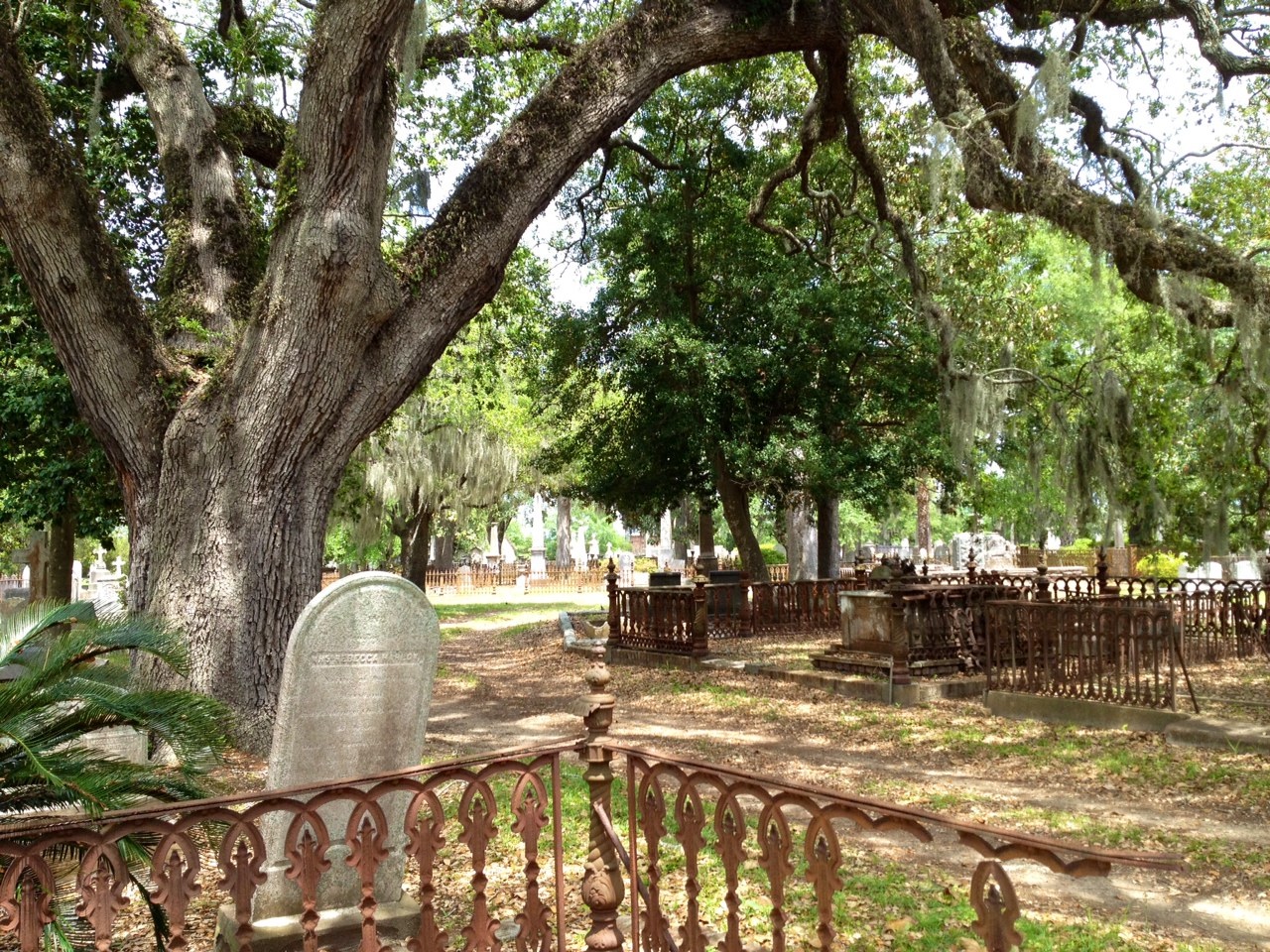
8)Our cemeteries are better than yours :) When I die I get to be surrounded by flowers planted beside me.  AND I don't even have to be in the back yard to do it! And if I want a pyramid to rest in, I can do that too.


9) Look whose back... two years ago I dug you up and moved you to my Mom's house.  Then you laid low and worked on a root system so you wouldn't flop and I wouldn't hate you so much.  And it worked...you are much better this go around. Good job, appleblossom yarrow.


10)Gratuitous salvia picture.


Tuesday, May 15, 2012

Still Life With Cat And Oleander

Mad cat lovin' graffiti artist strikes again in downtown Charleston!


Tuesday, May 8, 2012

The Fragrant Garden: My Top 10

The longer I do this gardening thing, the more I realize that as far as my aspirations to my "perfect garden," the smell of my garden is right up there with what it looks like.  I truly am trying to achieve a garden where you would recognize exactly where you were by scent alone if you were blindfolded, bound and gagged and brought to my house by kidnappers.  Of course, I would call the police if I wasn't kidnapped myself (or unless I had lost my mind and was the perpetrator!), but you, thanks to the smell, would be able to tell them exactly where they were hiding us once you wriggled one hand free enough to dial 911 on your cell.

But seriously, I want it to be year 'round.  I want my nose to sing with "verdant and alive" wafting through the air.

Now I have found that you need to time "layer" the scent makers, because many only bloom once a year.  Here's what I've found so far to be the most magnificent in the megawatt smell per square inch of plant, as well as the bloom time in my garden (z9a).  I'm talking wafting knock your socks off scent when you step out in the humid dusky air:

10) Oriental Lilies (May-June): These are common, we've all seen them, but I'm eagerly awaiting this guy pictured below to bloom none the less...will be any day now.

9) Pittosporum (March): A nice, almost non-descript large dense bush or small tree, it is often used for hedges.  Once a year in March usually, all of the sudden it is literally covered head to toe in tiny fragrant blooms which may be my favorite scent of the lot here.  They are called mock-orange, and though its sort of similar, it's really not.  They have a to-die-for fragrance.  Unfortunately, at least here, some years a heat wave will come in an make the blooms very short lived.  Even at their best they don't last more the 2-3 weeks.  But when they are out...

8) Wisteria (Late Feb-early March): I don't grow this myself, but it has practically eaten the south, so its everywhere.  It's what we hide our broken down vehicles and dilapidated roadside houses with.  It is the earliest seriously scented bloomer on the scene.

7) Honeysuckle (May-Sept): The scent of my childhood.  The dirt road our house was on was literally lined with these tangled in the bushes and its just such a sweet wonderful smell.  I know its invasive in some climates (like probably where I grew up come to think about it), but here it stays pretty much in check, at least compared to some of our other invasives.


6) Ligustrum (April): The bush we love to hate, it does have a redeeming quality and that it is a profuse bloomer with knock your socks off scent for nearly a month during the year.  It blooms here at the same time as another super fragrant flower too, so the month of April in my garden is almost overwhelming day and night.

5) Gardenia (May): I take it back on the pittosporum, the gardenia scent is probably my absolute favorite.  They don't waft quite as much though which takes it down a few notches, however still enough to smell it as you approach a bush without leaning down.

4) Brugmansia (June-Sept): This potentially deadly small tree is one of those that tries to attract pollinators at night, so it nearly bowls you over should you step outside after dark.  Its a cloying heady smell, very pleasant to me, but I have caught myself thinking that its the kind of scent that reminds you of an evil temptress.


3) Moon Vine (June-Sept): A true night bloomer, and a relative of the morning glory, I have smelled them in others gardens but this will be its first year in mine.

2) Confederate Jasmine (Late March-April): Until I planted #1, this was by far and away the most megawatt smelling dude in my garden.  I often hear people say that jasmine smells like gardenia and I honestly can't see how or why they would think that?  Jasmine to me has a peppery heavy sweetness, whereas gardenia is lighter and fruiter...well just not in the same nasal ballpark.  Anyhow, this variety is a ever-green vining plant which looks great in or out of bloom.  Non-invasive, which is a plus though they can grow extremely large, as mine has in 2.5 years.


1) Night Blooming Jasmine (May-Aug): This thing is ridiculous.  You need to plant it at least 30 feet from your house to be able to not get drunk on the scent.  It blooms on and off through the summer, and you can smell it down the block. I'm not kidding. Its nothing much to look at, a loose medium sized sprawly bush, but thats not the point.


There are so many others that can come tripping off my tongue that don't readily grow here so I didn't include them: Lilacs, Lavender, Hyacinths to name but a few.  Another one of my favorite of all garden smells comes from leaves, not flowers: the English Boxwood.  It just smells so, boxwoody to me.  I love it and it reminds me, every time I smell it, of the boxwood maze behind the old library in the small town where I grew up.

Also, there are all kinds of jasmine out there that can fight amongst themselves for the most fragrant plant ever.  I am considering getting the pink kind (Winter Jasmine), because it blooms in early March, before the others, but it is on the invasive list, and so far every time I've planted something invasive in this climate, it has, um, invaded.

You notice I didn't include the roses!  While many do have a lovely fragrance, they are not massive wafters on the whole.  Not a single rose I have compares with any of the above as far as megatwattage of scent making capacity, though I do obviously prefer those roses that smell.

Tuesday, May 1, 2012

The Maddening Gardenia

I know a lot of gardeners have trouble growing gardenias.  People try all kinds of advice to get those things to hold their blooms, grow, or even flower.  Or even just: not die!

Now, I never tried to grow a gardenia before I moved here so I'm not positive, but I truly truly believe the trouble is that despite what those evil lying plant tags say, they (gardenias) actually have a very limited growing climate.  If I had to guess I'd say they like:  humid as you can make it, zones 8a-10a, warm nights, part shade, crappy sandy soil that drains faster than a pasta strainer.  Thats what they like.  And even the part shade isn't that important, but the other things are.

Now why do I believe this?  Namely:


Yes, thats right, this is growing in the 'hell strip' outside of my next door neighbors house, beside the cement.  There's another one in a similar hell strip situation around the corner,  in half day sun living it up too.  Nobody waters these.  Nobody fertilizes, trims, or cares for them in any way.  I suspect the garbage collectors regularly smack em up with the bins.  And they look just as good as the two I actually throw some water on every so often in my garden.  Around the block a lady has them in patio pots in full sun and those suckers bloom themselves silly.


So here is my advice... if these plants grow literally like weeds in places they like (they compete with the oleanders and crape myrtles for the hell strip spaces) and you are struggling like crazy: it is not meant to be.   These plants, I suspect, have a narrower band of adaptability in reality that plant sellers would have you believe. For me, because of these same climatic conditions I can not grow most spring bulbs, I can't grow lilacs (or I can they just won't flower...sound familiar?), I probably can't grow half of the things that are in commercial garden existence.  So sure, try them out, but trust me, if they aren't working: its not you, its them.  They honestly don't care how nice you are to them, they are extremely picky about things you can't control.

I am coming to some of these same conclusions myself over what is just not meant to be.. it isn't worth wasting my time with in my Charleston climate.  Because no matter what zone you are in, there is SOOOO much that will grow!


Sunday, April 22, 2012

Brookgreen Garden Tour

This weekend I went to another of the garden estates around the area.  Like its English forebearers great estates were established here in the 17th-19th centuries, and also similarly, they are now the sites of some of the wonderful gardens in this area. From the website:
This was a rice plantation, one of the largest crops grown in antebellum times.

"During the Seventeenth Century, English settlers first came to the Carolina territory from Barbados and other Caribbean islands.  A plantation economy was well established on the islands, and the planters were looking to expand their holdings.  From the beginning, they brought enslaved Africans to work the new lands. The planters at The Oaks, Brookgreen, Springfield and Laurel Hill plantations (the four former plantations that make up the present-day Brookgreen Gardens) established family dynasties and were leaders of the rice planting elite during the antebellum years.  However, the success of these great rice plantations rested on the backs of the enslaved Africans.  As early as the mid-eighteenth century, a majority of the population in the Lowcountry of South Carolina were enslaved Africans and during the late antebellum period they accounted for almost 90 percent of the population in the region. They provided physical labor, skill and technology required for rice cultivation and production and infused the environment with their customs, traditions, crafts, and language known today as Gullah-Geechee culture."


Obviously this was a time of great wealth and fortune for a few, at the cost of freedom and hardship of the many.  

Today, its a sculpture garden
I was very taken with this statue and pool

Ballerina Roses and Daisies

Not all of the sculptures were classical!

What are considered weeds here have their own place!
Quite a bit of woodlands too

In the Child's Garden

Slightly cooler than Charleston, the tall snapdragons are still alive!

A scenic view on the walk

Love this pool

....a lot

The White Border (with Griffon)
One of the few copper statues

Foxgloves are at their height of glory

more Foxgloves

More snapdragons, with a larkspur or two

I think this is a Monsieur Tiller

The Muses in Fountain form

Another shot, it was beautiful
I was particularly taken by this sculpture holding a sculpture

Knockouts!

Snapdragons, foxglove
Its a formal garden but many portions have that slightly wild abandoned look that I love

I visited on a stormy day, in the 'in-between' season... after the spring magnificence but before the summer abundance... but still it was beautiful and informative.  You need about 2 hours to explore the formal gardens, and an additional 2 to walk the nature walks, plantation/rice fields area, see the butterflies and the zoo.

Wednesday, April 18, 2012

The Bumper Crop in Pictures

I missed GBBD, per usual, but its a bumper year for the Showy Evening Primrose (is there ever a year when it isn't a bumper year for those?) and the Star Jasmine.

So lets start with the Jasmine.  Last summer I decided to let the jasmine climb the tree on the corner of the fence.  This is what happens when you do this:


This is one star jasmine plant.  It is probably 30+ feet wide by 15 feet high.  And remember how happy we all were last year that this same plant survived a fungus that made it drop all of its leaves?  And remember me saying that it was looking rather pitiful, even though you all thought it looked fine?  Well, it has recovered.  Actually it still has the fungal disease but is slowly beating it.  Only about 25% of the leaves fell off this year.  And just to jog your memory, here's a picture of the same vine in May of last year, before massive climbing of tree.


And that same corner today:


Back to good health.  And behind the statue has filled in nicely too!

I know, its absurd the size of this thing in one year, and you can probably imagine the intensity of the scent around my house currently.  Okay, moving on to a true invasive, Oenothera speciosa, Showy Evening Primrose or Mexican Primrose.  I pull out about 90% of this each year.  I'm seriously considering putting in edging around it like you do bamboo.  Its sort of like that really pretty girl with the black heart in high school.  Its horrible and attractive all at the same time.  It will wrap its roots around other plants roots.  So they don't get any water at all.  Like it is evil.  Don't be fooled by these pictures.  You really really don't want this plant. 


In this next picture it is joined by a few of the plants I don't have cultivar names for.  That purple salvia is super cool...the stems are actually the exact same purple as the flower.  And those slightly peachy flowers are those of the "lowes nameless" miniature rose I bought last year.   The roses in the background for the most part are late bloomers and are about 2 weeks from full flush, and the foxgloves are out, and still standing this year, thanks to lack of wind and hail storms this spring.   The gaura is also a week or so from full flush, and of course, the hydrangeas who I loved dearly, kill me this time of year because they are so late to leaf compared to everything else.  Oh except for the echinacea, hands down the slowest thing out of the ground each year.  I swear its dead every year, but it never is.

But back to the point here: what I do love about it (the Oenothera), is that it sprawls so prettily... so few plants do this with any grace.


A few other shots from around the garden to round out the lot.  First the 'classic' (haw haw) red knockout rose with my cat, deet can and sluggo looking on:

And the remains of the first flush of the MAC rose.  This rose definitely suffered from both thrips and iron deficiency earlier in the year so isn't the prettiest its been, but still I'm not complaining.